Proposal for cooperation
Our Services
The overarching objective of our ESG support in the organisation is to implement effective and comprehensive solutions to the various challenges of the ESG, which can be achieved in a reasonable time and with a reasonable budget.
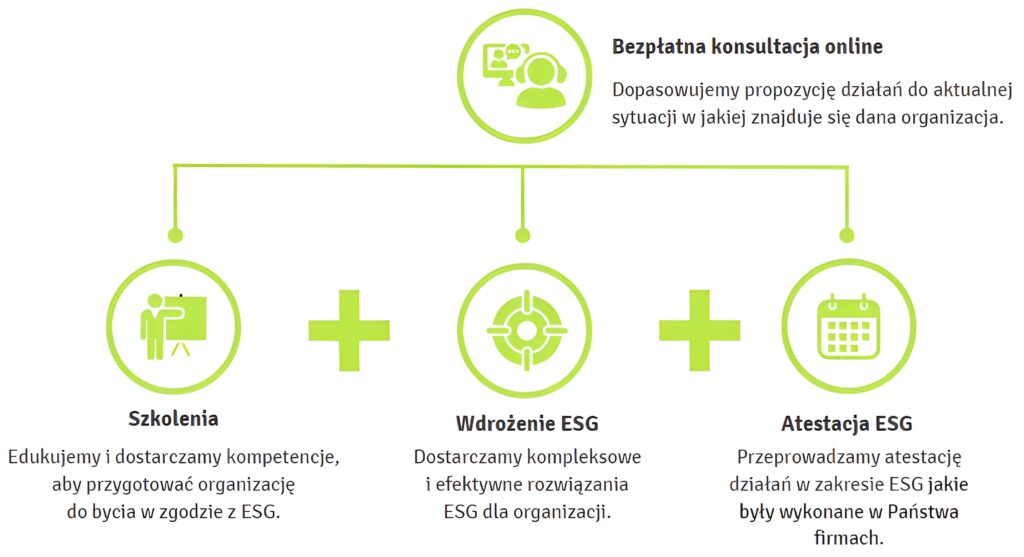
Proposal for cooperation
The proposed range can be completed in full, one task after another (or by an attestation of a given action,
if it was already done by another company) or only selected by you points that are needed for a given moment.
In order to prepare the report: dialogue with stakeholders, materiality studies and carbon footprint calculations.
A gap analysis is needed to prepare the strategy.
If these indirect actions have been carried out by another company, before the decision to cooperate with you on the report or strategy, we conduct a free mini-audit of the quality of those previous activities.
The validation of activities in the field of ESG performed by other companies is assessed individually depending on the scope of the activities.
It's done by certified auditors.
In the case of fixed activities in the location indicated by you, the cost of the delegation (river and accommodation) is added.

ESG training
Training dedicated to you online or stationary, in Polish or English.
Examples of topics:
- ESG reporting
- ESG strategy
- Decarbonisation and offset
- CSRD and ESRS standards
- Examination of relevance and dialogue with stakeholders
- Carbon footprint of organisation and product
- CBAM
- Closed Occlusion Economy
- Taxonomy
- Greenwashing
- ESG training dedicated to specific departments in the company (e.g. Shopping, Sales, Marketing, HR, IT, Accounting, Legal Department) which ensure the practical implementation of ESG rules in the activities of individual departments and processes in them
What you get at:
- Preparation of personalized training for your organisation
- Training (8 hours of teaching)
- Training material in the form of pdf
- Name certificates for participants in pdf form
If you want to know detailed programs and deadlines or book closed training, please contact us:

Workshop for management staff and persons responsible for the ESG
- Workshops to make the organisation aware of the future of the ESG
- Knowledge of key aspects of the ESG
- Identification of a group of stakeholders relevant for the organisation
- Establishment of an initial action plan for the ESG in the organisation
What you get at:
- Preparation of a personalised workshop, including competition analysis
- Workshops (6-8 hours, depending on the availability of management staff)
- Workshop material
- List of stakeholders relevant to the organisation
- Preliminary action plan for the ESG in the organisation

Dialogue with stakeholders
in accordance with the international commitment standard
stakeholders AA1000SES
- Preliminary workshop on dialogue with stakeholders
- Analysis of the stakeholder group and selection of organisations relevant for further work
- Design of an online survey for business stakeholders
- Performing an online survey among stakeholders
- If necessary, additional interviews with representatives of selected stakeholder groups
- Analysis of survey results of stakeholders and preparation of summary in the form of a report
- Preparation and support for feedback to stakeholders after the examinations carried out
What you get at:
- Preparation of a personalised preliminary workshop
- Workshop material
- Online survey form
- Analysis report of stakeholders relevant to the organisation
- Report on the survey of stakeholders
- Report on interviews with representatives of selected stakeholder groups (if any)
- Return communication to stakeholders after the examinations carried out

Assessment of relevance
in accordance with the CSRD Directive and the ESRS standards
- Preliminary workshop on materiality testing according to CSRD guidelines and ESRS standards
- Collection of the necessary information about the company for the purpose of examining relevance
- Preliminary assessment of relevant issues in terms of relevance of impact
- Preliminary assessment of relevant issues in terms of financial relevance
- Designation of stakeholders to carry out the materiality test
- Final assessment of relevant issues in terms of relevance of impact
- Final assessment of relevant issues in terms of financial relevance
- A matrix of dual significance
- Report of the materiality test
What you get at:
- Workshop material
- Preliminary and final assessment of relevant issues in terms of impact and financial relevance
- A matrix of dual significance
- Report of the materiality test

Analysis of gaps
in line with the CSRD and the ESRS standards (European Sustainable Development Reporting Standards)
- Preliminary workshop on CSRD guidelines and ESRS standards
- Review of existing internal policies in your organisation in view of potential reporting gaps in accordance with the ESRB for areas identified as relevant to the materiality study (where such gaps are found, improvement or creation of missing documents is further valued)
- If necessary, individual interviews with selected groups of representatives of organisations
- Summary of the report's analysis of gaps
What you get at:
- Workshop material
- The gap analysis review report

Organisational carbon footprint
according to GGG Protocol
- Preliminary workshop on coal footprint calculation
- Calculation of the carbon footprint of the organisation for range 1, 2 and 3, including:
- Determination of operational limits
- Preparation of data collection
- Data collection support
- Analysis of collected data
- Calculation of carbon footprint
- Carbon footprint report
What you get at:
- Workshop material
- Calculation of carbon footprint
- Carbon footprint report
Carbon footprint of products – for individual valuation

Taxonomy
in accordance with the EU Tax Code (Regulation (EU) 2020/852)
Assessment of each economic activity carried out by the Company as regards its compliance with taxonomy for additional disclosures in accordance with Article 8 of the EU Taxonomy Regulation, including:
- Verification of each economic activity carried out by the Company (according to the list of activities provided by the Company) in order to determine which of these activities qualify for taxonomy (taxonomy-eligible)
- Analysis of activities qualifying for taxonomy on their compliance with taxonomy (taxonomyalignment)
- Collection of information for disclosure required under Article 8 of the Taxonomy Regulation and Article 10(4) of Commission Delegated Regulation (EU) 2021/2178
What you get at:
- List of activities qualify for taxonomy (taxonomy-eligible)
- List of activities eligible for taxonomy as regards their compliance with taxonomy (taxonomy-alignment)
- Information for disclosure

Sustainable development strategy
according to the CSRD Directive
- Preliminary workshop on the Sustainable Development Strategy
- Developing an individual sustainable development strategy
- Preparation of a communication plan (internal and external) for a sustainable development strategy
- Summary of strategy in document form
What you get at:
- Workshop material
- Internal and external communication plan
- Strategy Paper

ESG report
in accordance with the CSRD Directive and the ESRS standards
- Initial workshops on ESG reporting
- Development of the data collection process
- Wsparcie w zebraniu danych
- Opracowanie wstępnego raportu ESG zgodnego ze standardami i wymogami regulacyjnymi dla poszczególnych typów
organizacji - Przedstawienie raportu ESG kadrze zarządzającej i zebranie informacji zwrotnej
- Opracowanie finalnej wersji raportu ESG uwzględniającej uwagi ze strony kadry zarządzającej
- Przygotowaniu planu komunikacji (wewnętrznej i zewnętrznej) dotyczącej raportu ESG
What you get at:
- Workshop material
- Dokument raportu ESG
- Plan komunikacji wewnętrznej i zewnętrznej dotyczącej raportu
Dla firm które muszą tworzyć raporty CBAM – możliwe jest wsparcie w tym zakresie, w tym dobór narzędzia

Atestacje
zgodne z wymaganiami formalno-prawnymi dotyczącymi danego obszaru
Atestacja ESG stanowi kompleksowy proces oceny, raportowania i udoskonalania działań przedsiębiorstw w obszarach środowiskowych, społecznych i zarządczych, mający na celu promowanie zrównoważonego rozwoju i tworzenie wartości dla wszystkich zainteresowanych stron.
Przykładowe obszary atestacji, jakie możemy przeprowadzić w zakresie ESG:
Ocena środowiskowa (Environmental assessment)
- Badanie wpływu działalności przedsiębiorstwa na środowisko naturalne.
- Analiza emisji gazów cieplarnianych, zużycia zasobów naturalnych, produkcji odpadów itp.
- Ocena zgodności z regulacjami dotyczącymi ochrony środowiska.
Ocena społeczna (Social assessment)
- Analiza relacji z interesariuszami, w tym pracownikami, klientami, społecznością lokalną.
- Ocena polityk zatrudnienia, praktyk bezpieczeństwa i zdrowia w miejscu pracy, zaangażowania społecznego.
- Ocena wpływu działań firmy na społeczność lokalną i ogólną społeczność.
Ocena zarządzania (Governance assessment)
- Ocena struktury zarządzania i kontroli w firmie.
- Analiza struktury zarządu, procedur podejmowania decyzji, przejrzystości w raportowaniu finansowym.
- Ocena zgodności z kodeksami etycznymi, standardami korporacyjnymi i przepisami prawnymi.
Pomiary i metryki (Measurements and metrics)
- Określenie kluczowych wskaźników wydajności ESG (KPI), które umożliwiają monitorowanie postępów w osiąganiu celów zrównoważonego rozwoju.
- Zbieranie danych liczbowych i jakościowych dotyczących aspektów środowiskowych, społecznych i zarządczych.
Raportowanie i certyfikacja (Reporting and certification)
- Przygotowanie raportów ESG, które podsumowują wyniki ocen oraz plany działań poprawczych.
- Możliwość uzyskania certyfikacji ESG, która potwierdza zgodność działań przedsiębiorstwa z określonymi standardami zrównoważonego rozwoju.
Rekomendacje i poprawki (Recommendations and remediation)
- Propozycje działań naprawczych i doskonalących, które mają na celu poprawę wyników ESG.
- Wsparcie w opracowywaniu i wdrażaniu strategii poprawy, które przynoszą korzyści zarówno dla środowiska, społeczności, jak i dla samego przedsiębiorstwa.
Monitoring i audyt (Monitoring and audit)
- Stałe śledzenie postępów i aktualizacja ocen ESG.
- Przeprowadzanie regularnych audytów wewnętrznych i zewnętrznych w celu zapewnienia zgodności z założonymi standardami i przepisami.
Atestacje działań z zakresu ESG wykonanych przez inne firmy jest wyceniana indywidualnie w zależności od zakresu działań. Atestacje wykonują certyfikowani audytorzy.
Chcesz poznać szczegóły?
Wyzwania w zakresie ESG i proponowane rozwiązania
Aby uzyskać szczegółowe informacje, kliknij przycisk „WYZWANIE” lub „ROZWIĄZANIE”.
Zbieranie i raportowanie danych
Zbieranie dokładnych i kompleksowych danych dotyczących ESG może być trudne, zwłaszcza w sytuacji złożonych łańcuchów dostaw.
Wdrożenie narzędzi do zbierania danych, bez dużych nakładów i optymalizowanie procesów raportowania.
Pełna zgodność z przepisami prawnymi
Zgodność z dynamicznie zmieniającymi się przepisami dotyczącymi ESG i standardami raportowania może być skomplikowana
Stały abonament wsparcia konsultanta, który na bieżąco śledzi zmiany w przepisach, i współpracuje z innymi ekspertami branżowymi
Realna integracja ze strategią biznesową
Włączenie wymagań ESG do strategii biznesowej może być trudne, zwłaszcza gdy jest opór wśród kadry zarządzającej.
Kształtowanie kultury zrównoważonego rozwoju, warsztaty wstępne z Zarządem i edukacja kadry kierowniczej w celu korelacji między celami biznesowymi a celami ESG.
Zaangażowanie Interesariuszy
Skuteczne zaangażowanie różnorodnych interesariuszy, w tym inwestorów, klientów, pracowników i społeczności, wymaga strategicznej komunikacji i przejrzystości.
Opracowanie strategii komunikacji i efektywne działania operacyjne w tym zakresie, aktywne pozyskiwanie opinii, i angażowanie interesariuszy w procesy podejmowania decyzji.
Ryzyko "Greenwashing"
W przypadku popełnienia błędów w raportowaniu, wynikających nie ze złej woli, ale z braku wystarczających kompetencji osoby zajmującej się ESG, istnieje ryzyko bycia podejrzanym o „greenwashing”, czyli celowym fałszowaniu rezultatów ESG w celach marketingowych.
Zapewnienie kompetentnego zespołu konsultantów, gwarantującego przejrzystość w raportowaniu, korzystanie z certyfikatów, rozliczanie się z realizacji konkretnych działań ESG w stosunku do tych zadeklarowanych.
Zarządzanie Talentami
Przyciąganie i utrzymywanie talentów, dla których zasady ESG są istotne, może być trudne, jeśli organizacja nie jest postrzegana jako społecznie i ekologicznie odpowiedzialna.
Promowanie zaangażowania w zrównoważone praktyki wizerunku pracodawcy, wdrażanie zrównoważonych praktyk w dziale HR, oraz oferowanie szkoleń i narzędzi edukacyjnych z zakresu ESG dla pracowników, klientów i dostawców.
Złożoność Łańcucha Dostaw
Raportowanie, a później dekarbonizacja w łańcuchach dostaw, zwłaszcza w branżach o rozległych sieciach, może być trudne.
Wsparcie we współpracy z dostawcami, określanie jasnych oczekiwań i wdrażanie kryteriów ESG w procesach zakupowych.
Percepcja Wydajności Finansowej
Duże koszty realizowania działań ESG mogą negatywnie wpłynąć na krótkoterminową wydajność finansową
Proponowanie racjonalnych wycen i sprawne działania, zminimalizowanie zaangażowania czasowego zespołów ESG, do zadań przynoszących wartość dodaną dla zespołu, minimalizując jednocześnie obciążenie innymi zadaniami, które bierzemy na siebie. Ograniczenia ryzyka związanego z „przepalaniem” budżetu ESG, oraz przedstawianie rozwiązań zwiększających efektywność organizacji i jej pracowników.
Technologia i Innowacje
Wdrożenie praktyk zrównoważonych może wymagać dużych inwestycji w nowe technologie i innowacje, co może być wyzwaniem finansowym i operacyjnym.
Opracowanie planu wdrożenia narzędzi w racjonalnej cenie, pilotaż narzędzi by sprawdzić działanie w Twojej organizacji.
Wymagania dla managerów ESG
Kompleksowość tematów ESG jest na tyle duża, że w zasadzie niemożliwe jest, żeby jedna osoba była w stanie zająć się wszystkimi tematami ESG, gdyż wymaga to wiele czasu i ciągłego śledzenia zmian i dobrych praktyk. Z drugiej strony, korzystając z usług różnych konsultantów zewnętrznych do różnych tematów, dużo czasu poświęcane jest na koordynację.
Wsparcie konsultantów na zasadzie edukowania organizacji do samodzielnego zajmowania się tematem, a kompleksowe wsparcie wszystkich tematów ESG przez jeden zespół konsultantów powoduje brak rozmytej odpowiedzialności.